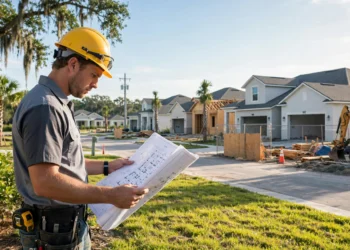


Pending home sales just fell to the lowest level ever recorded, and a second report the same morning shows builders pulling back too. The National Association of Realtors said on Tuesday that contracts to buy previously owned homes fell 7.3 percent from August and 11.3 percent from a year earlier. The Pending Home Sales Index dropped to 66.0, the lowest reading since the series began in 2001. Forecasters expected a slip of only 0.5 percent. After twenty years as a Florida real estate broker, I read this as the clearest snapshot yet of what high mortgage rates are doing to buyers and sellers.
Pending home sales by the numbers
Every region fell, on both a monthly and a yearly basis. The West took the hardest hit, down 9.2 percent in the month and 15.0 percent from a year earlier. The South, which includes Florida, fell 8.2 percent in the month and 12.0 percent from a year earlier. The Midwest fell 6.5 percent in the month and 8.7 percent in the year, and the Northeast fell 4.2 percent and 9.4 percent. Even the strongest metro areas fell, with the smallest yearly decline at 2.0 percent in the Nashville area.
Pending contracts matter because they usually close within one or two months. A sale counts as pending when the contract is signed but the transaction has not closed, so this report previews closings for October and November, and a record low points to a quiet finish to the year.
Housing starts fell the same morning
The Census Bureau added the supply half of the story a few hours earlier. Housing starts fell 5.2 percent in September to a seasonally adjusted annual rate of 1.221 million homes, below the 1.305 million forecast and down 7.4 percent from a year earlier. Single family starts fell 4.6 percent to a rate of 859,000. Building permits, which show what builders plan next, were nearly flat overall at 1.400 million, but the detail matters. Single family permits fell 4.0 percent to 845,000, the lowest level since April 2023. The South was the only region where starts rose, up 6.1 percent to a rate of 714,000.
This supply report landed one day after home builder sentiment fell to a 14 year low, and the two releases agree. Builders feel demand fading at current rates, so they are starting fewer single family homes and leaning on apartment projects instead.
One cause sits behind both reports
Lawrence Yun, chief economist at the National Association of Realtors, put the cause in plain words. Market conditions weakened in September due to fast rising mortgage rates, he said, and affordability responds more to mortgage rates than to job growth or income gains. Freddie Mac put the average thirty year fixed rate at 7.40 percent last week, the highest level in nearly three years and well above the 6.27 percent average of a year ago.
Run the household math on that gap. At the September median existing home price of 417,500 dollars, a buyer putting 20 percent down would pay about 2,313 dollars a month in principal and interest at 7.40 percent. At the 6.27 percent rate of a year ago, the same loan would cost about 2,061 dollars a month. That is roughly 252 dollars more every month, and more than 3,000 dollars over a year, before property taxes and homeowners insurance add a single dollar. Our guide to mortgage rates at 7.40 percent and whether to buy now or wait walks through that decision in full. Yun added that mortgage rates may be near a top, since they have risen much more than the short term rates set by the Federal Reserve, though rising energy prices leave that outlook uncertain.
Why prices are holding while demand falls
A record low in contracts sounds like the start of a price collapse, but the data does not support that fear yet. Yun noted that few distressed properties are coming to market, which keeps prices steady, and that many buyers and sellers are simply holding back until rates move in their favor. Millions of owners locked in far lower rates years ago and see little reason to sell and buy the next home at 7.40 percent, so supply stays thin even as buyers retreat. Fewer starts today also mean fewer finished homes competing for buyers next year. Weak demand and weak supply are falling together, which is why prices bend slowly instead of breaking.
For Florida households, the mortgage payment is only one layer of the cost of owning a home. Insurance premiums, property taxes, and association fees decide whether a payment that works on paper works in real life, which is why our Florida Homeownership Costs hub tracks the full stack in one place.
What this means for buyers and sellers
The lesson after twenty years of watching cycles like this one is simple. This is a rate problem, not a collapse in the desire to own a home. Demand has not vanished. It is waiting, and waiting demand tends to return quickly when rates ease, while the new supply that would greet it is now being cut back at the permit stage. Waiting for lower rates and lower prices to arrive together rarely works, because the first change usually cancels the second.
If you are buying, a thin market cuts both ways. You will compete with fewer buyers, and builders and sellers are more open to credits, rate buydowns, and price flexibility than a year ago, but you must qualify at the rate that exists today, not the rate you hope for next spring. If you are selling, understand that the buyers who remain are serious and rate sensitive, so pricing against nearby new construction and presenting a home that is ready to move into matters more than when contracts were plentiful. Sellers who test a high price in this market usually end up chasing it down.
Your move this month
First, if you plan to buy this year, get a full preapproval at the rates lenders quote today and write down the highest total payment you can carry with taxes, insurance, and association dues included, then shop only under that line. Second, ask every seller and builder about a rate buydown or a closing cost credit before you negotiate on price, because a buydown can cut your early payments more than a small price cut would. Third, if you plan to sell, price from the most recent comparable sales and from new build competition near you, not from the peak of last year. Fourth, keep your down payment growing in an account that pays a fair yield while you wait, so a rate dip finds you ready instead of hopeful. For more data, local guides, and buyer and seller strategy, visit the Real Estate Hub.
Want a calmer system for big decisions like this one? Download the free playbook at Unlocking Financial Freedom and get the practical money moves we share with readers who prefer clarity over noise. Use it to set your payment limit, your savings target, and your next step before the next report moves the market again.