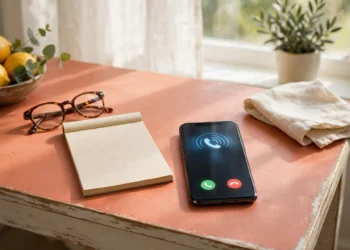


The call sounds official from the first second. A calm voice gives a real name, a real title and a courthouse you recognise, then tells you that you missed jury service and that a warrant now carries your name. The jury duty scam Florida sheriffs keep warning about works because it borrows real authority. In Osceola County this fall, the Sheriffs Office said scammers cloned the voice of a real captain and used his photo, and about forty residents received calls from someone claiming to be a county deputy.
Here is the lesson underneath the fear. No Florida court clears a warrant or a missed jury problem in exchange for money sent during a phone call. Once you know that single rule, the whole script collapses, no matter how real the voice sounds.
How the Jury Duty Scam Florida Callers Run Works
The script follows the same order almost every time. First comes the threat. You failed to report for jury duty, a judge has signed a warrant, and deputies are on their way unless you act now. Next comes the proof. The caller may name a real captain or judge, spell out a fake case number, or send a photo and a document that look like court paperwork. Then comes the payment. You are told to stay on the line, drive to a store or a kiosk, and send money by gift card, crypto, a payment app or a wire so the warrant can be recalled before you are arrested.
Staying on the line is part of the trap. It stops you from calling anyone who would tell you the truth. Our guide to FTC scam calls and fake agents shows the same pressure pattern in a different uniform, because government impersonators all sell the same product, which is panic with a deadline.
The Three Red Flags That Give It Away
Florida prosecutors summed this scam up with three red flags, and every fake call carries at least two of them. The first is the channel itself. You learn about real jury service by mail, in an official summons with a date, a courthouse and instructions you can verify. The Broward courts put it plainly in a joint warning this summer: members of the public are never contacted initially by email or phone for jury service. A first contact that arrives as a call or a voicemail is already the wrong shape.
The second red flag is the threat of immediate arrest. Real sheriff offices do not call ahead to warn you that you are about to be arrested, and they do not offer to cancel an arrest for a fee. The warning call exists for one reason only, to give you a chance to pay. The third red flag is the payment method. No court and no law enforcement agency asks you to clear a fine with gift cards, crypto at a kiosk, a payment app or cash handed to a courier. Untraceable payment is the point of the whole call, and the moment you hear it requested, you are not talking to a court at all.
Why the Voice Sounds So Real Now
Voice cloning changed the trust test. A short clip of a public official speaking at a meeting or in a news story can be enough raw material to build a convincing copy, and the Osceola case shows callers pairing that copy with a real photo and a real name. That is why listening harder is the wrong defence. Our AI voice scam guide for families makes the same point for a different setting: you cannot reliably judge a voice by ear anymore, so you judge the request instead.
Judge the request with two questions. Is this person asking me to send money right now, and is this person trying to stop me from checking through a number I find myself? A yes to either question ends the call. Real business with a real court can always wait ten minutes while you verify it, and it will still be there when you call back on an official number.
What to Do If You Get One of These Calls
Hang up, even in the middle of a sentence. You owe a stranger on the phone no courtesy and no explanation. Do not call back the number the caller gave you, and do not use a number printed on any document the caller sent. Look up the number yourself on the official court or sheriff website, then call and ask whether any jury or warrant matter exists in your name. In almost every case the answer is no, and you have spent five calm minutes instead of thousands of rushed dollars.
In Broward County, the courts ask residents to report state jury duty scam calls to the Broward Sheriffs Office at 954 831 8901, and federal jury duty scam calls to the US Marshal Office at 954 356 7256. Elsewhere in Florida, report the call to your local sheriff office and to the Federal Trade Commission at ReportFraud dot gov. If you already sent money, call your bank or the payment company at once, then file the same reports while the details are fresh. Speed matters more after a payment than pride does, and recovery odds fall with every hour you wait.
Share this rule at home tonight, especially with older relatives who answer every call and who trust a uniform voice. Our Scam Proofing hub gathers the family checklist versions of these checks in one place, so you can walk through the toll text, the fake agent call and this jury call in a single sitting.
Your action today is simple. Save one line in your phone notes and tell your family the rule out loud: courts summon by mail and never take payment by phone. When the scary call comes, and for many Florida households it will, that one sentence is the difference between a story you tell at dinner and a loss you explain to your bank.
For a wider system of protecting your money and cutting household costs step by step, download the free ebook Unlocked Vol 2: The Financial Freedom Playbook. It walks through the saving, debt and income moves that matter most in one short and practical read. Open it tonight and add the jury call rule to the list of money protections your household has in place before the next scam call rings.